PromoStandards Core Services — Distributor Workflow Overview
PromoStandards is a set of XML/SOAP-based standards designed to standardize communication between distributors and suppliers in the promotional products industry. Each service focuses on a specific business capability, and together they form an end‑to‑end integration lifecycle.
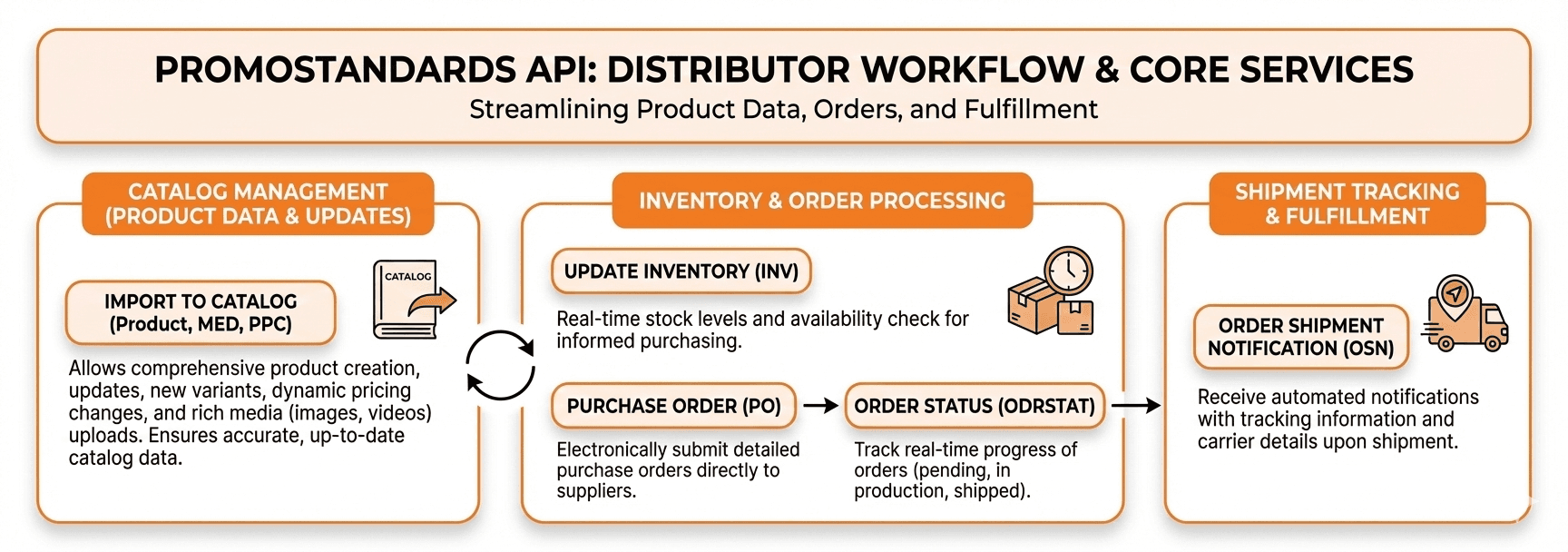
High-Level Distributor Workflow
From a distributor’s perspective, the lifecycle typically looks like this:
- Build and maintain a product catalog
- Import product data, pricing, and media from suppliers
- Keep availability accurate
- Frequently update inventory levels
- Place orders with suppliers
- Submit purchase orders
- Track fulfillment
- Receive order status updates
- Notify customers of shipment
- Receive shipping confirmations and tracking numbers
Each PromoStandards service maps directly to one or more of these steps.
1. Product / Pricing / Media Import
Services:
Main Goal
To allow distributors to build and maintain a searchable, sellable product catalog using standardized supplier data.
What It Provides
-
- Product names, descriptions, categories
- Attributes like sizes, colors, materials
- Supplier SKUs and product identifiers
-
- Base pricing tiers
- Decoration methods and locations
- Upcharges, setup fees, and run charges
- Minimum quantities and quantity breaks
-
- Product images (blank and decorated)
- ArtTemplates, virtual samples, and supporting assets
- Image metadata (angle, color, resolution, part relationships)
Distributor Value
- Creates a single internal catalog across many suppliers
- Enables search, merchandising, and quoting
- Reduces manual data entry and supplier-by-supplier differences
Position in Workflow
Foundation layer — everything else depends on accurate product, pricing, and media data.
2. Inventory Availability
Service:
Main Goal
To provide near real-time stock availability so distributors can sell with confidence.
What It Provides
- Inventory levels by:
- SKU / part
- Color
- Size
- Warehouse / location
- Optional future availability or backorder indicators
Distributor Value
- Prevents overselling
- Enables accurate delivery expectations
- Critical for ecommerce storefronts and automation
Typical Usage Pattern
- Polled on a schedule (every few hours or daily depending on the supplier)
- Queried just-in-time during checkout or quoting
Position in Workflow
Operational accuracy layer — keeps the catalog sellable and trustworthy.
3. Purchase Order Submission
Service:
Main Goal
To allow distributors to electronically place orders with suppliers in a standardized format.
What It Provides
- Order header information
- Distributor info
- Supplier info
- Order dates and references
- Line items
- Products and quantities
- Decoration details
- Shipping information
- Ship-to addresses
- Shipping methods
- Artwork references or attachments (depending on implementation)
Distributor Value
- Eliminates manual order entry (email, fax, portals)
- Enables straight-through processing
- Scales order volume without increasing staff
Position in Workflow
Transaction execution layer — converts a sale into a supplier order.
4. Order Status Updates
Service:
Main Goal
To provide visibility into the lifecycle of an order after submission.
What It Provides
- Order-level and line-level status updates
- Common statuses include:
- Received
- In production
- Backordered
- Shipped
- Cancelled
- Estimated ship dates and revisions
Distributor Value
- Reduces “where is my order?” inquiries
- Enables proactive customer communication
- Supports internal exception handling
Typical Usage Pattern
- Polled on a schedule
- Sometimes triggered by supplier-side updates
Position in Workflow
Fulfillment visibility layer — tracks progress from order to shipment.
5. Order Shipment Notification
Service:
Main Goal
To notify distributors when an order (or part of an order) has shipped.
What It Provides
- Shipment confirmation
- Carrier and service
- Tracking numbers
- Ship dates
- Partial shipment details (split shipments)
Distributor Value
- Enables automated customer notifications
- Allows tracking links to be surfaced in portals
- Feeds accounting, invoicing, and CRM systems
Relationship to Order Status
- OSN is often the final milestone after ORDSTAT
- Some suppliers rely more heavily on OSN than detailed status polling
Position in Workflow
Customer fulfillment layer — closes the loop from supplier to end customer.
End-to-End Workflow Summary
- Import Catalog
- Product Data + Pricing + Media build the catalog
- Maintain Accuracy
- Inventory Availability keeps listings trustworthy
- Execute Sale
- Purchase Order submits the order to the supplier
- Monitor Progress
- Order Status tracks production and changes
- Complete Fulfillment
- Order Shipment Notification confirms delivery
Together, these services form a modular but complete integration contract between distributors and suppliers.
Key Insight
PromoStandards is not a single API — it is a workflow language for the promotional products industry.
Distributors who implement all services gain:
- Operational scale
- Fewer manual touchpoints
- Better customer experience
- Stronger supplier relationships
Suppliers who implement them well become:
- Easier to do business with
- More attractive to high-volume distributors
- Better positioned for automation-driven growth